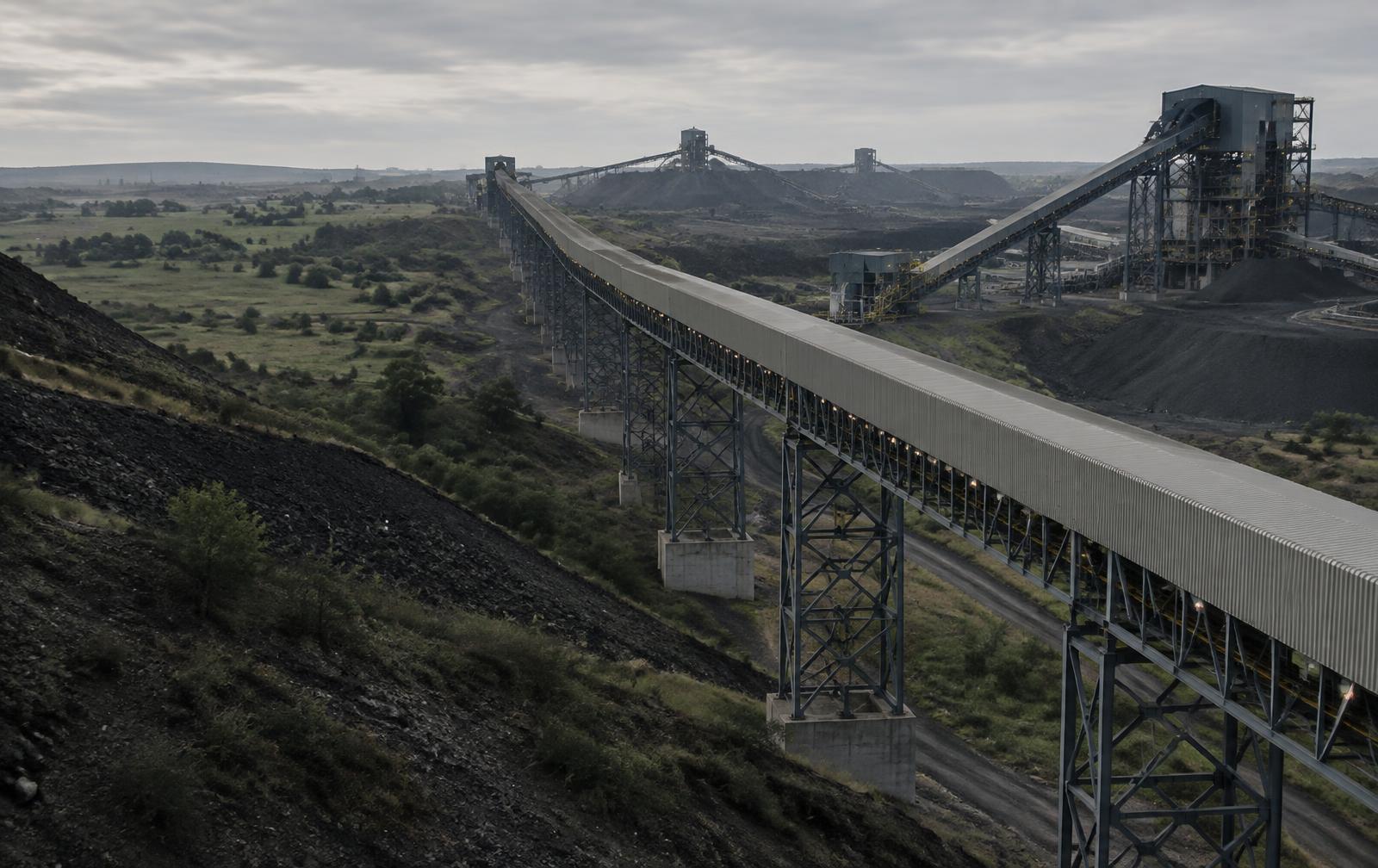
A 6 km pit-to-plant conveyor. Bankable only if the floor is.
Triad Mining and Logistics is seeking a capital partner to fund, build, own and operate a proposed approximately 6 km overland coal conveyor at Arnot under a ten-year BOOT service contract, before transfer to the mine. At R30/t on 300,000 t/month it earns R108m a year at full volume. Against the R397m funding requirement, that is about 27% of the capital each year. Whether it carries debt depends on the minimum payment, the mine’s credit and a capex that funders can verify.
Development-stage proposal. All figures are client terms, research estimates or arithmetic on them, and remain subject to technical, commercial, credit and legal due diligence.
The engineering is modest. The floor, the counterparty and the capex decide.
At R30/t on 300,000 t/month the conveyor earns R108m a year at full volume — 27.2% of the client’s R397m BOOT funding requirement. Use the rate toggle below to move the tariff up or down from R30/t. Whether that cash flow can carry debt depends almost entirely on how the minimum monthly payment is defined.
R1 steps, or type a value from R15 to R50. The rate applies to every calculation on this page.
| Item | Value | Basis |
|---|---|---|
| Base revenue | R9.0m/month · R108.0m/yr | R30.00/t × 300,000 t/month (client terms) |
| Revenue vs funding | 27.2% of R397m a year | Full-volume revenue as a share of the funding requirement |
| Contracted minimum (floor) | R4.5m/month · R54.0m/yr | 150,000 t/month (50% of design) × R30.00/t, paid whether or not coal is conveyed |
| Capex benchmark | R110–330m for 6 km | EUR 1–3m/km vendor guidance |
| Client funding requirement | R397m · ≈R66m/km | Incl. IDC, fees, Eskom connection, contingency |
| Simple payback on R397m | ≈4.8 yrs at base · ≈13.7 yrs at 50% | R25m/yr indicative opex |
| Senior debt cost | 10.25–11.75% floating | JIBAR 7.25% + 300–450 bps |
| DSCR at 60% gearing (R238.2m), 11% | 2.05x at 100% · 0.72x at 50% floor | Debt service R40.4m/yr; lenders need 1.2–1.4x |
| Rate for the 50% floor to carry debt | R36.36/t at 1.0x · R40.85/t at 1.2x | Tariff at which the floor alone covers debt service |
| Time to first coal | 27–35 months | 15-month build + permitting |
Ready to test
The tariff sits inside the R25–R40/t trucking band, the asset is physically modest and the 2026 cost of capital is knowable.
Not yet bankable
The 150,000 t/month floor covers only about 0.72x of debt service, the mine counterparty is unproven and R397m sits above international installed-cost guidance.
What would change it
A rand-denominated monthly capacity charge — at R397m and R30/t, about 70% of base revenue covers debt service at 1.2x — credit support linked to the mine’s offtake chain and capex confirmed by OEM budget quotations.
Important context / Revenue figures are arithmetic on the client’s tariff and capacity. Opex, capex and rate inputs are indicative research values, not contracted terms.
R30/t sits inside the trucking band and removes diesel risk.
No published short-haul coal trucking tariff exists for the area, so the comparison is built bottom-up: truck running costs of R12–15/t, front-end loader loading of R8–12/t and roads, dust, weighbridge and supervision of R5–10/t give an indicative all-in R25–R40/t over 6 km in 2026 rand.
Diesel volatility
Inland wholesale diesel reached a record R31.95/l on 7 October 2026. A conveyor tariff indexed to CPI and electricity removes that exposure from the mine’s cost base.
Haul traffic
Roughly 290 side-tipper loads a day of on-site traffic, haul-road upkeep and dust are avoided. Public-road externalities matter only if the truck route uses public roads.
The honest caveats
Carbon savings are thin on Eskom’s grid, and R30/t is about 2.8 times the global all-in benchmark of R10.5–11/t for 6 km. The tariff must be defended bottom-up.
Important context / The pitch must rest on risk transfer rather than headline saving: against low-cost trucking, R30/t is roughly break-even; against high-cost trucking, the mine saves up to about R36m a year.
Size the conveyor for the tonnes the tariff actually pays for.
The EOI (TCE-OLC-EOI-001 Rev 02, closing 29 October 2026) is collecting OEM rough-order estimates at 1,000, 1,250 and 1,500 t/h. Its 848 t/h average requirement on a 26-day, 16-hour, 85% calendar means 1,000 t/h is already about 85% utilised.
01 / Feed interface
Validate pit sources, coal characteristics, loading method and stockpile capacity against a ten-year mine plan.
02 / Corridor
Complete survey, ground investigation, watercourse crossings and registered servitudes along the 6 km route.
03 / Power
No power on route; Eskom supply is about 4 km away. Connection route, cost and timing are a capex and schedule item.
04 / Capacity headroom
1,250 or 1,500 t/h buys expansion headroom that R30/t on 300,000 t/month does not pay for unless the mine commits to more tonnes.
Important context / The visual here is a conceptual interface diagram, not a surveyed alignment or approved route. No route drawing is included in this site.
R397m must be reconciled line by line before funders trust it.
The client’s R397m funding requirement equals about R66m/km all-in. International vendor guidance of EUR 1,000–3,000 per metre implies R110–330m installed for 6 km. The remaining R67m or more must be explained by the Eskom line, interest during construction, fees and contingency.
Estimate accuracy
At EOI stage, civils are AACE Class 5 (−20/−50% to +30/+100%) and mechanicals at best Class 4. Show a −20%/+30% band and 15–25% contingency.
Energy
Eskom Megaflex 2026/27 blends to about R2.35/kWh for a flat load. At 1.4–2.0 kWh/t that is R1.4–4.7/t, or R5–17m a year at 3.6 Mtpa.
Total cash opex
No sourced SA benchmark exists for maintenance, insurance or crew. The planning figure is R20–30m a year (R5–10/t); R25m is used here.
Important context / Belt life on clean-coal steel-cord duty is plausibly 10–15 years, so a mid-life replacement falls largely after handover. Electrical long-leads (40–80 weeks) are the documented procurement bottleneck.
Lenders size debt off the contracted floor, not the base case.
The client’s minimum payment is 150,000 tonnes a month — half the 300,000 t design — paid at the tariff whether or not the coal is conveyed. At R30/t that is R4.5m a month, or R54m a year. After R25m of opex it covers only about 0.72x of debt service at 60% gearing on R397m. Test how a higher floor or a capacity charge changes debt capacity.
Important context / The 150,000 t/month minimum must be drafted as an enforceable take-or-pay obligation, payable on availability and matched to the mine’s offtake term, before any funder engagement.
A floor is only as good as the party paying it.
The single largest exposure a funder will underwrite is the mine. Junior Mpumalanga collieries with ten-year Eskom contracts have entered business rescue within 14 months of signing, and five Highveld power stations are scheduled to close in 2030 — year four of the tariff.
Track record
Arnot OpCo signed a ten-year, conveyor-fed Eskom coal supply agreement in August 2021 and was in business rescue by October 2022. Vanggatfontein, Optimum and Tegeta followed similar paths.
Reserves
Banks lend against Proved, not Probable, reserves. A “30+ year life of mine” claim is atypical for the Witbank field; ten years at 3.6 Mtpa needs about 36 Mt.
Throughput reality
A Witbank case study showed plant yields 25–54% below geological prediction. Test P50/P90 at 70–85% of nameplate and wet-season quarters at 75–85%.
Years 1–4
Relatively secure demand: Eskom burnt 96.5 Mt in FY2026 and API4 was $127.95/t on 27 Oct 2026.
Years 4–8
The cliff: Camden, Hendrina, Grootvlei, Arnot and Kriel (≈7.4 GW) slated to close in 2030. Slippage is plausible but not lendable.
Years 8–10
Depends on the receiving station (Kendal, Kusile, Duvha, Matla, Tutuka run past 2034), third-party rail access and reserves.
Important context / Arnot power station is one of the five Highveld stations slated for 2030 retirement. The receiving station and offtake for this mine’s coal must be identified before any post-2030 revenue is relied on.
Is this worth considering? Test it before anyone commits.
Toggle the tariff up or down from R30/t, then change volume, floor structure, capex, financing and term. Seven screening tests show the investor and the mine, in plain terms, whether the case is worth progressing to a full model.
R397m, 50% tonnage floor, ten-year term, research debt terms.
Tariff
R1 steps, or type a value from R15 to R50. The rate applies to every calculation on this page.
Minimum payment structure
Client terms: a minimum of 150,000 t/month (50% of design), paid at the tariff whether or not the coal is conveyed.
Volume
Cost
Financing
Term & mine alternative
1 screening test fail. Change the structure or close the evidence gaps before taking this case to funders.
- FailContracted floor covers debt service0.72xFunder · Pass ≥ 1.20x · watch ≥ 1.00x
- PassScenario minimum DSCR2.05xFunder · Pass ≥ 1.30x · watch ≥ 1.00x
- PassEquity IRR clears hurdle23.6%Funder · Pass ≥ 20% · watch ≥ 15%
- PassProject IRR above debt cost16.3%Funder · Pass ≥ 13.0% · watch ≥ 11.0%
- PassSimple payback inside contract term4.8 yrsBoth · Pass ≤ 8.0 yrs · watch ≤ 10 yrs
- PassConveyor cheaper than trucking for the mineR30.00/t vs R32.50/tMine · Pass ≤ trucking · watch ≤ trucking + 10%
- WatchCapex intensity within benchmarkR66m/kmBoth · Pass ≤ R55m/km · watch ≤ R80m/km
The client model reports a 16.2% project IRR and 23% equity IRR. At R397m and R30/t this simplified ten-year model gives about 16.3% and 23.6% at full volume with no indexation — close to the client’s figures. Confirm the client model’s term, tax and residual-value assumptions.
Annual cash flow vs debt service
Bars in red fall below 1.00x debt service. Year 5 is calendar 2030 if commercial operations start in 2026; first coal is realistically 27–35 months from a decision, which moves the cliff earlier in the term.
Sensitivity: tonnage floor × funding requirement
| Floor / charge | R330m | R397m | R437m | R476m |
|---|---|---|---|---|
| 50% | 0.86x | 0.72x | 0.65x | 0.60x |
| 75% | 1.67x | 1.38x | 1.26x | 1.15x |
| 90% | 2.15x | 1.79x | 1.62x | 1.49x |
| 100% | 2.47x | 2.05x | 1.86x | 1.71x |
All other assumptions as currently set, including the R30.00/t tariff. R330m is the top of vendor installed-cost guidance; R397m is the client’s funding requirement; the last two columns add 10% and 20% overruns.
Tariff sensitivity: rate up or down from R30/t
| Tariff | Revenue / yr | Minimum revenue / yr | Floor DSCR | Minimum DSCR | Equity IRR | Mine saving / yr | Signal |
|---|---|---|---|---|---|---|---|
| R90.0m | R45.0m | 0.49x | 1.61x | 8.8% | R27.0m | Fail | |
| R99.0m | R49.5m | 0.61x | 1.83x | 16.6% | R18.0m | Fail | |
| · client · selected | R108.0m | R54.0m | 0.72x | 2.05x | 23.6% | R9.0m | Fail |
| R117.0m | R58.5m | 0.83x | 2.27x | 30.1% | R0.0m | Fail | |
| R126.0m | R63.0m | 0.94x | 2.50x | 36.4% | R-9.0m | Fail | |
| R144.0m | R72.0m | 1.16x | 2.94x | 48.5% | R-27.0m | Fail |
All other assumptions as currently set. Select a rate to apply it across the deck.
Important context / Simplified annual, pre-tax screening model. Excludes tax, VAT timing, reserve accounts, construction-period interest beyond what is in capex, and residual value unless a transfer payment is entered. Not a forecast, tariff offer or investment recommendation.
The 2026 funding window is narrow, but open.
No South African bank policy excludes logistics infrastructure serving an existing mine. The realistic funder universe for a ticket of about R400m is the IDC (if the coal feeds Eskom), Afreximbank co-finance, structured lending to a creditworthy sponsor, OEM vendor finance, trader prepayments and mezzanine slices.
IDC
Continues to support coal feeding existing power stations on energy-security grounds; US$8bn Afreximbank partnership names mining and infrastructure. Support is conditional — it withdrew from Boikarabelo in 2020.
Relationship banks
Policies close new thermal mines but not logistics for existing mines. Nedbank and Standard Bank cap coal exposure at 0.5–1% of book; corporate or structured lending to a creditworthy sponsor is likelier than limited-recourse SPV debt.
OEM & vendor finance
Precedent: Komatsu Financial’s US$113m fleet facility for Boikarabelo.
Traders & mezzanine
Commodity traders have played a big role in structured coal funding; mezzanine funds such as Kholo can provide R50–200m slices at 16–20%.
| Cost of capital | Rate | Basis |
|---|---|---|
| Repo rate | 7.25% | After 25 bp hike, 23 Sep 2026 |
| Prime | 10.75% | From 25 Sep 2026 |
| 3-month JIBAR | 7.25% | October 2026 |
| 10-year government bond | 8.73% | October 2026 |
| Senior debt (floating) | 10.25–11.75% | JIBAR + 300–450 bps |
| Senior debt (fixed) | 11–13% | Swap curve still to be retrieved |
| Mezzanine | 16–20% | SA mezzanine targets |
| Equity hurdle | 18–25% | Nominal rand, single-offtaker coal logistics |
What lenders will ask for
- Debt tenor 8–9 years inside the ten-year contract, sculpted to the capacity charge
- Minimum DSCR 1.2–1.4x; 1.5–1.7x in downside tests; LLCR 1.7–2.0x
- Six-month DSRA plus three-month maintenance reserve
- Cost-overrun facility of 5–10% of capex
- Interest-rate hedging or a fixed tranche
- Independent engineer, EPC liquidated damages and performance bonds
- Direct agreement with the mine and tripartite acknowledgement from Eskom or the export buyer
- Mine collection account held with a major SA bank
Important context / REIPPPP achieved 70.8% gearing and 10.2% senior debt, but with a sovereign-backed 20-year offtake and no volume risk — a floor, not a benchmark. No third-party tariff-based conveyor BOOT was found in SA or the region for 2018–2026, so funders will price this as bespoke structured credit.
Build. Own. Operate. Transfer — as a services contract.
A dedicated project company would fund, own and operate the conveyor and charge the mine a tolling fee. The mine must retain all mining decisions, remain the MHSA employer and licence holder, so nothing is “let or sublet” under MPRDA s11.
The project company owns and operates the conveyor and charges the mine a tolling fee, secured by cession of coal receivables, a debt-service reserve and lender step-in rights.
Security package
Cession of coal receivables into a lender-controlled account, a six-month debt-service reserve (about R20m on 60% gearing of R397m), parent guarantees, cross-default and lender step-in.
Handover
Lenders give no credit to post-contract value. Full recovery by year 8–9, or a credit-supported transfer price or termination payment at least equal to outstanding debt.
Tax
A non-right-holder cannot safely rely on the s36 100% allowance. Model s11(e) wear-and-tear with s12C as upside; avoid a lease structure (s23A); 15% VAT with a construction VAT bridge.
Important context / Project company ownership, debt and equity participation, security rights and transfer terms remain to be agreed. No equity allocation is offered here.
Permitting, not fabrication, sets the date of first coal.
The EOI’s 15-month build is credible, but the s102 amendment, NEMA Basic Assessment, water-use authorisation, servitudes and an Eskom connection put first coal 27–35 months from decision. Only the mining-right holder can lodge the applications.
Important context / Durations combine statutory clocks with observed backlogs. Early works that need no environmental authorisation can start around month 6 at the sponsor’s risk.
Clear responsibility from design to dependable service.
Triad Consulting Engineers is proposed to lead design, project management and construction management, with an appointed OEM executing the works and Triad Mining and Logistics operating the conveyor for the project company.
Triad Consulting Engineers
Design basis, multidisciplinary engineering, procurement support, controls, supervision and handover.
Appointed OEM
Supply, construct and commission under a fixed-price EPC with liquidated damages and performance bonds.
Triad Mining & Logistics
Operate and maintain to agreed availability standards, under the mine’s conveyor Code of Practice (GN R1024) with SANS 971 belting.
Independent engineer
Funder-appointed review of design, budget, progress and acceptance. Availability guarantees should carve out s54 stoppages not caused by the operator.
Important context / EPCM and OEM obligations would be contracted separately. A single fixed-price completion guarantee is not established.
Match each material risk with evidence and a mitigant.
Risks ranked by their likely weight in a funder’s credit paper. Rankings are the research author’s judgement from the cited evidence, not measured frequencies.
Close the data gaps before a funder sees the case.
Use this checklist with the mine to track what is known. Each item is something the current documents do not yet say, and that a funder or independent engineer will ask for.
Source register
From “is R30/t enough?” to “who guarantees how much of it?”
Presented as a two-party commitment — with the mine’s permitting and floor obligations drafted as tightly as the funder’s build obligations, and the R397m confirmed by an EPC budget quotation — the deal fits the 2026 window the IDC, Afreximbank and relationship banks have left open for logistics serving existing coal supply.
The discussion now
Development funding appetite, preferred floor structure, credit support from the mine’s offtake chain and the partner’s diligence process.
The first decision
Fund a development stage to obtain OEM pricing, permitting, a confirmed floor and a full model — then decide on delivery funding.
Important context / This is an indicative, non-binding invitation to discuss the project. No funding commitment or securities offer is made.